
from the studio
AN ARTICLE BY ALLY TAYLOR
Let me start with something that might make you uncomfortable: if you’re over 50 and think your daily walk is keeping you strong and independent, you’re wrong.
I know, I know. Your GP probably told you to “keep active” and praised your 10,000 steps. But here’s what they didn’t tell you: walking does virtually nothing for sarcopenia (age-related muscle loss), bone density, or the strength you need to get up from the floor, carry shopping, or live independently into your 80s.
This isn’t opinion. It’s what the research says. And yet, the fitness industry, and even parts of the medical establishment, keep repeating comfortable lies that are quietly robbing older adults of their quality of life.
I’ve spent years in this industry myth-busting, so let me be clear: I’m not here to sell you on trendy workouts or Instagram-friendly exercises. I’m here to show you what the actual science says about strength training after 50. Some of it will challenge what you’ve been told. But if you’re serious about ageing well, you need to hear it.
Myth 1: “Walking Is Enough Exercise”
This is perhaps the most dangerous myth of all, because it sounds so reasonable. Walking is free, accessible, and low-impact. What’s not to love? The problem is this: walking is cardiovascular exercise. It trains your heart and lungs. What it doesn’t do, at all, is preserve the muscle mass and bone density that keep you independent.

A 2026 systematic review published in Springer Link examined the effects of resistance training on older adults. The results? Resistance training improved muscle strength with an effect size of 0.71 (that’s considered a medium-to-large effect in research terms) and significantly enhanced walking ability. But here’s the key finding: walking itself doesn’t provide enough mechanical load to trigger the adaptations you need.
Think about it this way: your body adapts to the demands you place on it. Walking signals your body that you need cardiovascular endurance. Lifting progressively heavier weights signals your body that you need to maintain and build muscle and bone. They’re completely different stimuli.
The research on sarcopenia, the gradual loss of muscle mass that begins around age 30 and accelerates after 50, is unequivocal: resistance training is the only intervention proven to significantly slow or reverse it. Not walking. Not swimming. Not even yoga (though it has other benefits). Strength training.
Without adequate muscle mass, every aspect of daily life becomes harder. Getting out of a chair. Climbing stairs. Carrying bags. Eventually, you lose independence. And that’s when quality of life plummets.
Myth 2: “Lifting Heavy Is Dangerous at My Age”
Right. So you’ve been told that strength training is important, but you should stick to light weights and high repetitions because anything heavier is dangerous for older joints and bones. Let me ask you something: where did this advice come from? Because it certainly didn’t come from the sports science literature.
A 2022 meta-analysis in Sports Medicine examined progressive resistance training (PRT) in older adults, that’s training where you gradually increase the weight over time. The findings were striking: PRT increased bone mineral density in the hips and femurs by approximately 2.77% and significantly improved lower-body strength.
Here’s what’s ironic: the very thing people fear, loading your bones with heavy resistance, is exactly what preserves bone density. Your bones, like your muscles, respond to mechanical stress. Light weights don’t provide enough stimulus to trigger adaptation. Moderate-to-heavy progressive loading does.
Wolff’s Law: your body adapts to the specific stress you give it
This is Wolff’s Law in plain English: bone remodels itself along the lines of stress you repeatedly put through it. Not “exercise” in general. Not “being active.” Specific, repeated loading patterns.
And it’s not just bone. Muscle, tendons, and even fascia adapt to what you ask them to do. So if all you ever do is move in straight lines (endless linear squats, presses, and machine-based patterns), your body gets very good at those lines of force… and less robust everywhere else.
That’s why movement variability matters for long-term health. Different stances, different angles, different grips, rotation, carries, stepping, hinging, getting up and down from the floor, moving laterally. Real life isn’t a perfectly symmetrical barbell path, and your training shouldn’t be either (especially as you get older and want resilience, not just numbers on a lift).
“Heavy” is relative – what matters is getting close to failure
This is where people get confused. They hear “lift heavy” and picture 100kg deadlifts or a crowded gym full of egos. But “heavy” is relative to you. What actually drives strength and muscle retention is taking a set close to muscular failure (i.e., you’re within a few reps of “I physically can’t do another clean rep”). You can do that with:
- bodyweight (if you choose the right variation)
- dumbbells/kettlebells
- resistance bands/cables
- barbells
- machines
- tempo changes, pauses, and range-of-motion tweaks
So no, you don’t need to chase maximal loads to get the benefits. You need smart exercise selection, progressive challenge, and sets that are hard for you. That’s also how you keep training enjoyable and sustainable (because the best programme is the one you’ll actually do).

Yes, form matters. Yes, you need proper programming. But the research repeatedly shows that when done correctly, progressive resistance training is not just safe for older adults, it’s essential.
A 2023 study published in Frontiers in Physiology found that men in their 70s and 80s who had never trained before built muscle just as effectively as lifelong athletes after beginning a resistance training programme. The adaptation doesn’t stop at 50, or 60, or 70. Your body remains remarkably responsive to the right stimulus.
The weighted vest / rucking trend: great for cardio… not magic for bones and muscle
Weighted vests and rucking are having a moment, and I get it: it feels productive, it bumps your heart rate, and it can make a walk more “workout-y” without feeling like a workout. But let’s be precise about what it’s doing. Yes, adding load tends to increase metabolic demand and heart rate. So for cardiovascular fitness (and general conditioning), it can be a genuinely useful tool.
No, a casual walk around Sheepleas with a modest vest usually isn’t a meaningful structural stimulus. It’s typically not heavy enough, not intense enough, and not close enough to failure to reliably drive changes in muscle mass or bone density. Unless you’re carrying truly high loads (think military-grade ruck weights, and even then with careful progression), it’s mostly just a tougher walk, not a replacement for progressive resistance training.
So if you enjoy it, brilliant: keep it in as cardio. Just don’t let it become the comfortable loophole that stops you from doing the thing that actually preserves strength, muscle, and bone. The actual risk? Not lifting. Weak muscles mean poor balance, which means falls. Weak bones mean fractures. The evidence is clear: exercise is safer than sitting still.
Myth 3: “You Can’t Build Muscle or Strength After 50”
This myth stems from a partial truth: yes, muscle protein synthesis becomes slightly less efficient as we age. Yes, hormonal changes (particularly the decline in testosterone and growth hormone) affect muscle-building capacity. But here’s what the research actually shows: you absolutely can build significant muscle and strength after 50. The process may be slower than it was at 25, but it still works.
That same 2023 Frontiers in Physiology study I mentioned? Untrained older adults experienced meaningful hypertrophy (muscle growth) and strength gains comparable to younger cohorts when they followed a structured resistance training programme.
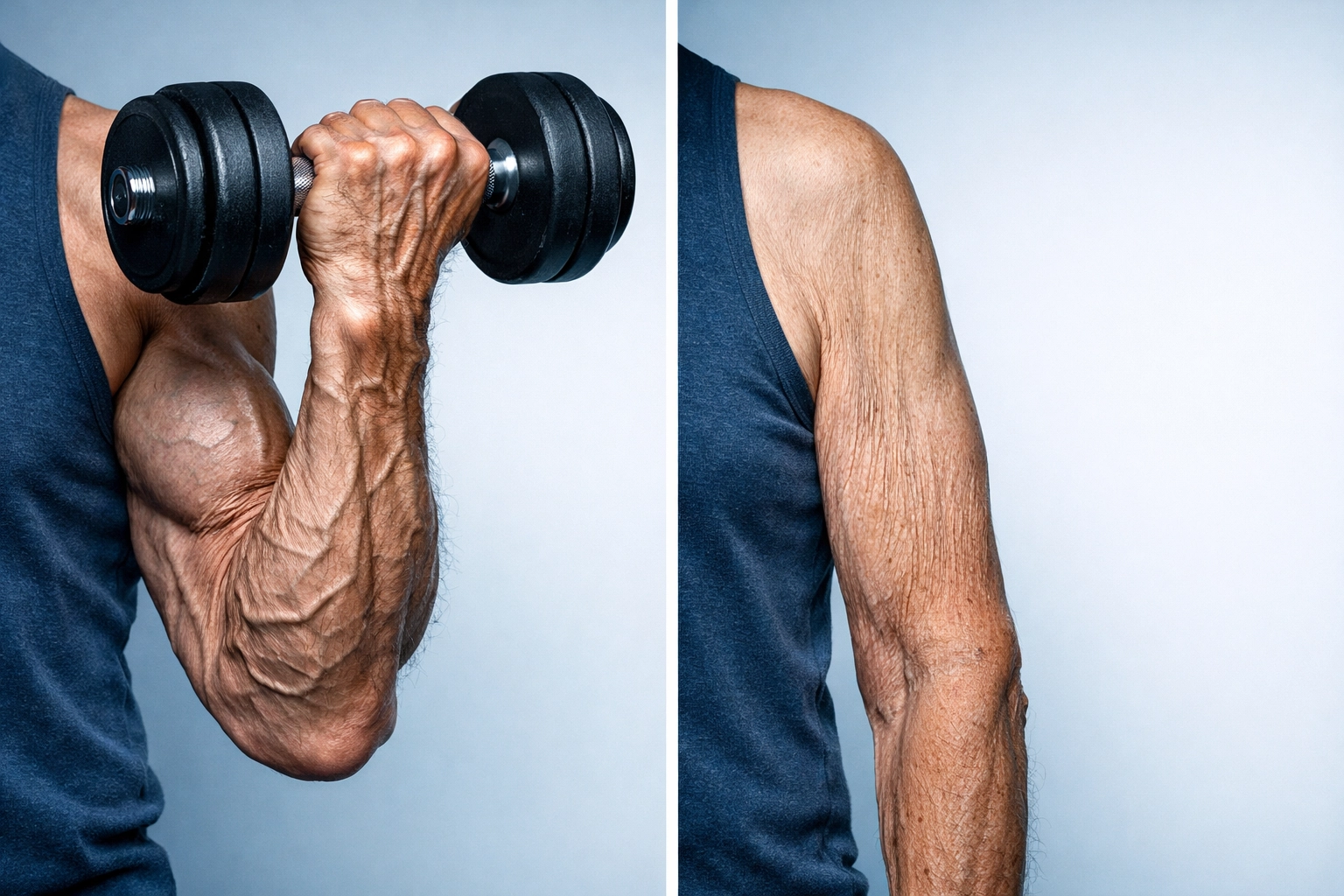
A 2026 review examining resistance training interventions in older populations found consistent improvements in muscle strength, functional performance, and body composition across dozens of studies. The effect was dose-dependent: meaning the more consistently people trained, the better their results.
What does change with age is your recovery capacity. You might not bounce back from a hard session quite as quickly as you did decades ago. But that doesn’t mean you can’t train hard: it means you need to be smarter about programming rest and recovery. The idea that you’re “too old” to get stronger is simply not supported by the literature. Full stop.
Myth 4: “Strength Training Makes You Stiff and Inflexible”
This one makes me laugh because it’s the complete opposite of reality. The myth probably comes from seeing bodybuilders who can’t scratch their own backs (usually the result of muscle imbalances and neglecting mobility work, not strength training itself). But properly designed resistance training actually improves mobility and joint function.
Why? Because strength through a full range of motion requires mobility. When you squat deeply, you’re training hip, knee, and ankle mobility. When you press overhead, you’re training shoulder mobility. When you deadlift, you’re training hip hinge mechanics.
The research backs this up. Multiple studies have shown that resistance training, particularly when performed through full ranges of motion, maintains or improves flexibility in older adults. In fact, strength at end-range positions is precisely what prevents injury and maintains functional movement capacity. Here’s the thing: stiffness in older adults typically comes from not moving, not from moving too much. Joints that aren’t regularly taken through their full range lose that range. Muscles that aren’t loaded become weak and tight. The solution is movement under load, not avoiding it.
So What Should You Actually Do?
Look, I get it. If you’ve spent years avoiding the weights section of the gym (or avoiding gyms altogether), this is a lot to take in. But here’s the reality: the single most important thing you can do to maintain independence, bone density, muscle mass, and quality of life as you age is progressive resistance training. Not walking. Not gentle yoga. Not swimming. Those things are lovely and have their place, but they don’t address the fundamental problem of age-related strength and muscle loss.
You don’t need to become a powerlifter. You don’t need to train six days a week. But you do need to consistently challenge your muscles with progressively heavier loads, through full ranges of motion, with proper form. The good news? You’re not too old. It’s not too late. And when done properly, it’s not dangerous: it’s the safest investment you can make in your future self.
If you’re in East Horsley and want to learn how to do this properly, in a supportive environment with coaches who actually understand the science, have a chat with us. We specialise in exactly this: intelligent, evidence-based training for people who want results, not Instagram-worthy workouts.
Your 70-year-old self will thank you.
Be The First To Comment