
from the studio
AN ARTICLE BY ALLY TAYLOR
Here are three human thighs – quadriceps if we are being technical – in cross-section, courtesy of an MRI scanner. You don’t need a physiology degree to read these photographs.
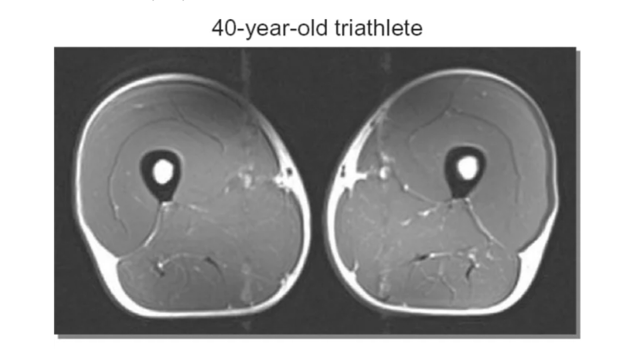
This one belongs to a 40-year-old triathlete. Dense, tightly packed muscle, dark on the scan, wrapped neatly around the bone. This is what well-used tissue looks like.
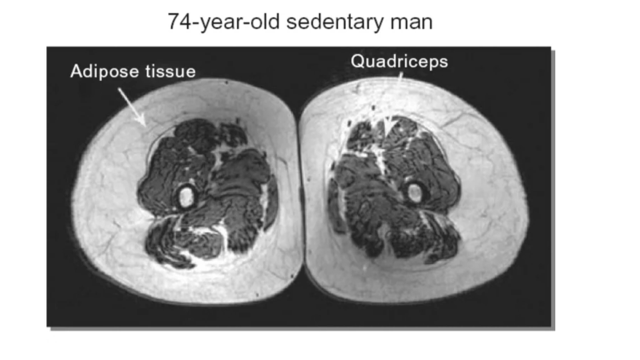
This one belongs to a 74-year-old man who stopped exercising decades ago or maybe never did. Similar overall proportions, same bone sitting in the middle, if a bit smaller, but the muscle has been colonised. Pale streaks of fat run straight through tissue that used to be solid, and a thick ring of it sits around the outside where muscle used to be. He stopped asking his body to do anything difficult, and his body took him at his word.
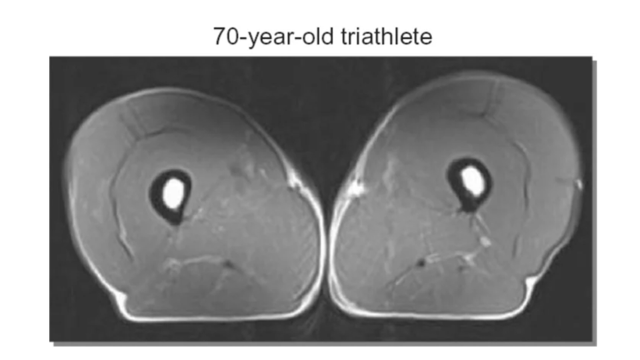
This one belongs to a 70-year-old triathlete: thirty years older than the first scan, four years younger than the second. His thigh looks remarkably like the 40-year-old’s. Dense muscle, minimal fatty infiltration, a similar cross-sectional area.
These three images come from a study by Wroblewski and colleagues, comparing lifelong masters’ athletes against sedentary adults of similar age (2011), and the finding underneath them is the whole point of this article. Much of what gets filed under “normal ageing” in muscle isn’t ageing at all. It’s disuse, photographed.
Why the fat matters more than the size of the muscle
It’s tempting to look at these scans and focus on size, but the pale infiltration in the sedentary scan isn’t inert padding. Fat marbled inside and between muscle fibres, known in the literature as intermuscular adipose tissue, behaves like an active tissue. It releases inflammatory signalling molecules and interferes with the muscle’s ability to respond properly to insulin. More fat threaded through the muscle means worse blood sugar regulation and less metabolic reserve. This isn’t a cosmetic problem. It’s part of what determines whether an occasional biscuit gets handled sensibly or turns into a long-term liability.
The functional consequences aren’t to be sniffed at either. Lower-limb strength is one of the more reliable predictors we have of who lives independently into old age and who doesn’t, and resistance training is associated with meaningfully lower all-cause mortality risk This is not a vanity metric for social media. It’s much closer to a survival metric.
So what counts as strength training?
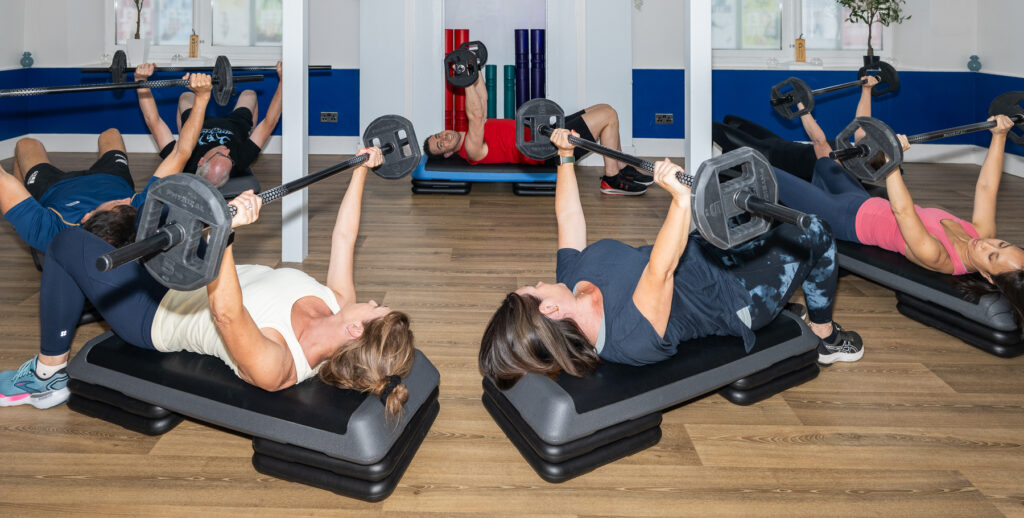
This is where people get it wrong, usually with the best intentions. Feeling your muscles work, that local burn from a long Pilates hold or a deep yoga pose, isn’t nothing. It builds endurance, control and body awareness, and belongs in a well-rounded week and is called muscle activation. But activating a muscle and building it are two different signals, and the body is scrupulously literal about telling them apart. We activate muscles all day when moving around, but if that was enough to move the needle on everything above, then GP surgeries and hospitals would have much shorter wait times to be seen!
Muscle, bone and connective tissue only adapt when asked to do something they currently can’t quite manage. That’s the entire mechanism: overload the tissue relative to its present capacity, and the body upgrades it to cope next time. Stay comfortably within what it already handles, however long you hold the position, and there’s no signal to adapt to. Without progression, adaptation stalls. The old saying “do what you’ve always done and get what you’ve always had’ rings true here!
In practice, that means reaching real effort, the point where good technique is at risk on the next repetition, at least once a week, ideally two or three times. It needn’t be overwhelming. A few hard sets of a squat, a hinge, a press and a pull will do more for your muscles than an hour of gentle movement, however virtuous it feels.
Bone plays by different rules
Bone is fussier still. It doesn’t respond to muscular effort in general; it responds to mechanical strain through the bone itself, and there’s a threshold below which nothing happens at all. This is called Wolff’s Law in physiology. Below a certain level of strain, bone stays exactly as it is, however virtuous your walk was, and even with that weighted backpack! Above it, bone remodels and strengthens.
For the bones in your legs and hips, that threshold is usually reached through actual impact: foot meeting floor with some force that is 2-3 times greater than your body weight. That’s why walking, however good for the heart and brain, rarely shifts bone density on its own, while jumping, skipping and heavy lower-body lifting reliably do.
Train in every direction, because tissue does too
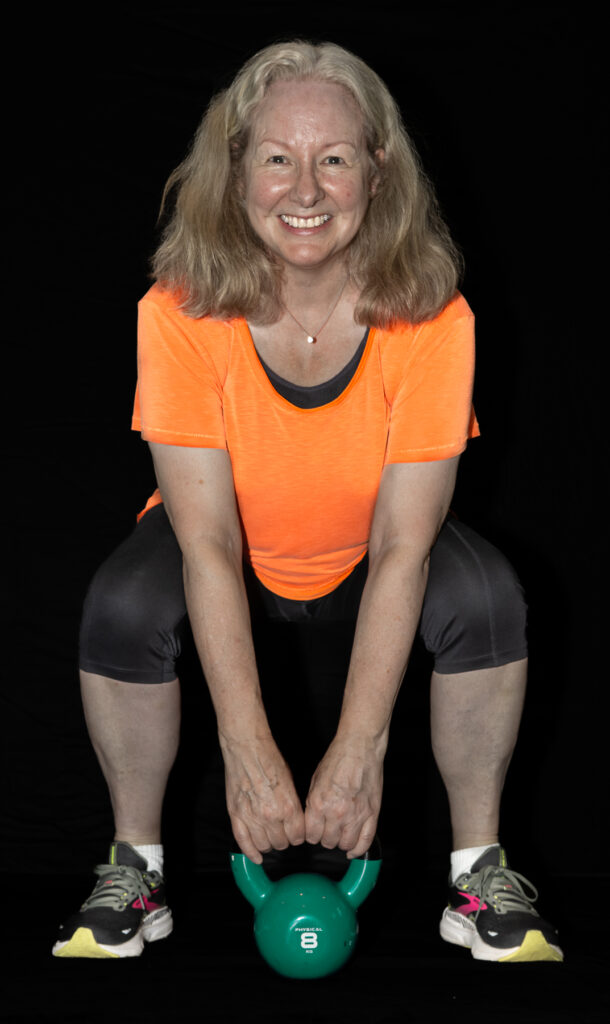
One last principle, and this is important. Muscle, bone and tendon all adapt along the specific lines of stress placed upon them, and no further. A programme built entirely around forward-and-back, up and down movement produces a body that’s strong forward and back, up and down, and no more resilient than before in rotation, sideways, or under an uneven load, which is precisely how most falls and injuries happen once we step outside the controlled environment of the gym. We call this being gym strong and not life strong. There are 3 planes of motion in human movement, all of which can be combined when we step outside the gym into the wild! Pushing, pulling, hinging, bending, carrying, rotating, leaning and landing – the tissue adapts to all of it so we need to train all of it.
None of this requires a gym subscription or a personality transplant. It requires occasionally doing something a bit too hard, on purpose, more than once a week if you can manage it and doing it regularly, for the rest of your life.
The scans above show you what happens either way. Choose wisely.
References
American College of Sports Medicine (2009) ‘Progression models in resistance training for healthy adults’, Medicine & Science in Sports & Exercise, 41(3), pp. 687–708.
Frost, H.M. (1987) ‘Bone “mass” and the “mechanostat”: a proposal’, The Anatomical Record, 219(1), pp. 1–9.
Goodpaster, B.H., Thaete, F.L. and Kelley, D.E. (2000) ‘Thigh adipose tissue distribution is associated with insulin resistance in obesity and in type 2 diabetes mellitus’, American Journal of Clinical Nutrition, 71(4), pp. 885–892.
Shailendra, P. et al. (2022) ‘Resistance training and mortality risk: a systematic review and meta-analysis’, American Journal of Preventive Medicine, 63(2), pp. 277–288.
Wroblewski, A.P., Amati, F., Smiley, M.A., Goodpaster, B. and Wright, V. (2011) ‘Chronic exercise preserves lean muscle mass in masters athletes’, The Physician and Sportsmedicine, 39(3), pp. 172–178.
Be The First To Comment